
Monthly Archives: October 2014

By Caitlin Harder
Reprinted from Cornell Chronicle, October 20, 2014

Pawan Angara discusses his spotted wing drosphila research with College of Agriculture and Life Sciences Dean Kathryn Boor. - Mark Vorreuter

On Oct. 7, 26 students from the College of Agriculture and Life Sciences (CALS) and College of Human Ecology (CHE) gave one-minute “lightning” presentations on topics ranging from helping New York farmers adapt to climate change to market testing alternative sap products and offering classes to second-time parents.

The presentations were followed by a poster session that outlined what the students learned through research conducted during the Cornell Cooperative Extension Summer Internship Program.
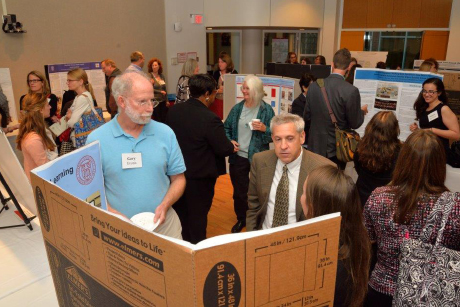
Human Ecology Dean Alan Mathios and faculty member Gary Evans mingle with the Cornell Cooperative Extension interns. -Mark Vorreuter
Human Ecology Dean Alan Mathios and faculty member Gary Evans mingle with the Cornell Cooperative Extension interns. - Mark Vorreuter

Pawan Angara ’16 conducted research on spotted wing drosophila, an invasive species that lays its eggs in otherwise viable fruit, creating significant losses for organic farmers in the Hudson Valley. Angara spent his summer developing a gel that attracted the insects to a location where they could be exterminated.

Angara discovered that field research doesn’t always go as planned. “You have to adapt and work with the tools you have on hand, rather than what you wish you had,” he said. “I definitely was inspired by all the innovation I saw in the lab and the quick thinking that went on. When you’re in the field, you can’t just drive back to the lab to get something you forgot.”

This was his second summer participating in the program. “Every year I see more and more people doing great things for the community and great things for the world through research,” he said.

Lindsay Dower ’15 updated a curriculum on nutrition and fitness and taught modules to middle school children in Canandaigua. Applying the research of Valerie Reyna, professor of human development, Dower tested a theory that learning by understanding overarching ideas is more effective than memorizing facts. “I learned so much about the research process and, beyond that, how to work with different groups and types of people … and I definitely strengthened my leadership skills,” Dower said.  She is continuing her research in Reyna’s Laboratory for Rational Decision Making this academic year.

Food science major Susana Jimenez ’15 spent her summer in Wayne County working to increase participation of traditionally underrepresented Latino children in local educational opportunities. Building on the research of CHE senior lecturer Pilar Parra, Jimenez conducted interviews and focus groups and learned that parents and caregivers in the rural area showed high interest in extension programs. She identified and evaluated sites, learning that hosting programs in familiar spaces with established community leaders, such as Catholic churches, increased program participation. She said these groups wanted to learn about nutrition and food safety, but they were open to many of kinds of programs. “It’s not so much what you teach, but where and how,” she said.

Since its establishment in 2007, the Cornell Cooperative Extension Summer Internship Program has expanded from five student projects to 26.

Caitlin Harder is a writer intern for Cornell Cooperative Extension.
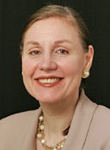
 

Valerie Reyna, professor of human development in Cornell's College of Human Ecology commented recently  on the rising fear of Ebola in the United States for the PBS News Hour, the Huffington Post, and for the Cornell Press.

Valerie Reyna
Reyna

“The layperson’s perception of risk from Ebola is understandable from a psychological perspective. People often think in terms of categorical possibilities—especially about horrifying possibilities. They are told that transmission is categorically impossible, then the impossible happens--twice. Two healthcare workers get infected. Suddenly, the impossible becomes possible and people are naturally fearful."

“It is crucial to understand the public’s perception of risk as an integral part of public health efforts to control infections, whether those infections are HIV, HPV and its vaccine, or Ebola. The science of human perception and behavior cannot be ignored because it is a key part of keeping the nation safe.”

For PBS newshour, October 16, 2014, she elaborated: "now, psychologically, people have shifted from, this is an impossibility to, not only is it a possibility, but it’s one that’s increasing. And the human mind is keenly attuned to change, to increases in risk, as well as changes from impossible to possible."

Fear actually spreads from person to person similarly to how a physical virus is transmitted, Reyna said in her interview with Huffington Post, October 17, 2014. And if a risk is unfamiliar to us -- something that we've never experienced and may not understand the actual of level of risk associated -- it tends to produce more dread, says Reyna.

Related Link:

Valerie Reyna featured in the Human Ecology Magazine

Reprinted from Cornell Chronicle, August 13, 2014

Corinna Loeckenhoff, associate professor of human development, is the 2014 recipient of the Margret M. and Paul B. Baltes Foundation Award in Behavioral and Social Gerontology from The Gerontological Society of America (GSA) – the nation’s largest interdisciplinary organization devoted to the field of aging.

This annual award, which Loeckenhoff will receive at GSA’s 67th Annual Scientific Meeting, Nov. 5-9 in Washington, D.C., recognizes outstanding early career contributions in behavioral and social gerontology.

Loeckenhoff directs the Laboratory for Healthy Aging in the College of Human Ecology at Cornell. She has published more than 35 refereed journal articles, many in the flagship journals in psychology and aging. Her groundbreaking research revolves around age differences in socio-emotional functioning and their implications for health-related decision-making and outcomes. Recently she has focused on translating findings from laboratory-based decision-making paradigms to real-world health care settings.

Her work also has major implications for understanding barriers to optimal decision-making among older adults and their family members who face challenging choices in the face of life-threatening illnesses. Her research program focuses on the role of stressful life events, social relationships, and balancing present and future well-being.

Her work, at an early career stage, has contributed to understanding age differences in time horizons, personality and emotion. In addition, she has done fundamental research on lifelong trajectories in personality traits and social cognition. Particularly notable, Loeckenhoff’s work has shed new light on the impact of these phenomena on mental and physical health, with attention to cultural differences.

Loeckenhoff received her undergraduate degree from the University of Marburg in Germany (1999) and a Ph.D. in personality psychology from Stanford University (2004).

Related Links:

Corinna Loeckenhoff
College of Human Ecology

Study cracks brain’s emotional code
The human brain turns feelings them into a standard code that objectively represents emotions across different senses, situations and even people, reports a new study by Cornell neuroscientist Adam Anderson.
Book lauds land-grant university model
The land-grant university, 150 years after its inception, remains an extraordinary and compelling model for higher education, with ideas and ideals relevant to even the most elite academies, contends Robert Sternberg in “The Modern Land-Grant University.”
Book examines hows and whys of economic choices
Drawing on perspectives from the early roots of psychology through the latest neuroscience, the new volume edited by Valerie Reyna and graduate student Evan Wilhelms introduces what we know about how and why people make decisions with economic consequences.
Poor neighborhoods – not poor parents – pack on pounds
By age 2, poor children have gained more weight than those who are better off. But after age 2, neighborhood poverty, not family poverty, is linked to weight gain, finds a new study by Gary Evans.
Girls’ perceptions drive sexual behavior
Jane Mendle’s latest research suggests that genetic factors related to how sexually mature a girl thinks she is influence her sexual behavior, above and beyond her actual physical development.
Online avatar helps demystify breast cancer risk
Valerie Reyna and colleagues developed a computer-based system using artificial intelligence designed to mimic one-on-one human tutoring to help women understand breast cancer genetics.
Kids’ earliest memories might be earlier than they think
The very earliest childhood memories might begin even earlier than anyone realized – including the rememberer, his or her parents and memory researchers, according to new research by Qi Wang.
Survey: ‘Mostly heterosexuals’ have more health problems
The largest minority on the sexual-orientation spectrum – the mostly heterosexuals, estimated at around 7 percent of the general adult population – report more health problems than heterosexuals and somewhat fewer than bisexuals finds a review by Ritch Savin-Williams.
Institute for the Social Sciences grants awards
Nathan Spreng is among those who received research awards from the Insititute for the Social Sciences in the Fall of 2013 for research on Brain Network Dynamics.

Students in the News

Win or lose, this computer game teaches biology
Andrew Jefferson, a graduate student in the field of human development, is spearheading development of video games to teach young people about science.
Undergrads convey their research prowess at forums
More than 20 of the students presenting at the Cornell Undergraduate Research Forum were HD majors or worked with a professor in the department.

More Stories

Experts offer new findings on youth at research update
Service-learning event honors student, faculty projects
Workshop offers roadmap to link research, practice
Moving beyond IQ
Expressions of fear and disgust aided human survival, study says
The aging brain network
Love is a story

New Resources

Embryos, stem cells, human meaning and policy
Media Literacy