Author Archives: ktb1@cornell.edu

By Karene Booker

Hamilton
Hamilton

Mentoring relationships are a powerful tool for helping young people find their way - to higher education, good jobs and other opportunities - especially for youth with fewer family resources. However, we know little about the most common form, natural mentoring,  in which adults act as mentors outside of the context of a program set up for that purpose. Now, a new project, funded by the William T. Grant Foundation, aims to help close this knowledge gap.“Fostering natural mentoring is a promising approach to increasing mentoring for the youth who need it most,” said principal investigator Stephen Hamilton, professor of human development and associate director for youth development at the Bronfenbrenner Center for Translational Research in Cornell’s College of Human Ecology.

Through survey research, the project will shed light on the roles mentors play for youth (supporting, modeling, connecting, and guiding), how these roles are linked to the background and outcomes of the youth, and how to foster natural mentoring, Hamilton said.

The $25,000 project got underway in December 2013 and will continue through June 2014.  Mary Agnes Hamilton, senior research associate at the Bronfenbrenner Center for Translational Research, and David DuBois at the University of Illinois at Chicago, are Co-PIs on the project. The research will involve youth from two schools in California - High Tech High, a charter school in San Diego and a YouthBuild program in Lennox.

Karene Booker is an extension support specialist in the Department of Human Development.

Related Information

By H. Roger Segelken
Reprinted from the Cornell Chronicle, January 13, 2014

The joke’s on a generation of human-sexuality researchers: Adolescent “pranksters” responding to the widely cited National Longitudinal Study of Adolescent Health in the mid-1990s may have faked “nonheterosexuality.”

Preliminary results from the landmark study – known as “Add Health” – stunned researchers, parents and educators alike, recalls Cornell’s Ritch C. Savin-Williams, professor of human development: “How could it be that 5 to 7 percent of our youth were homosexual or bisexual!” Previous estimates of homosexuality and bisexuality among high schoolers had been around 1 percent.

So imagine the surprise and confusion when subsequent revisits to the same research subjects found more than 70 percent of the self-reported adolescent nonheterosexuals had somehow gone “straight” as older teens and young adults.

“We should have known something was amiss,” says Savin-Williams.  “One clue was that most of the kids who first claimed to have artificial limbs (in the physical-health assessment) miraculously regrew arms and legs when researchers came back to interview them.”

Now Savin-Williams is the co-author (along with Kara Joyner of Bowling Green State University) of an invited essay in the journal Archives of Sexual Behavior that was published online Dec. 24, "The Dubious Assessment of Gay, Lesbian and Bisexual Adolescents of Add Health."

The Add Health study (with more than 14,000 participants in four “waves” between 1994 and 2009) was intended to “assess various social and familial contextual variables that influence health, well-being and health-related behaviors” of American young people.

Over the years, analyzing Add Health’s sexual-orientation data became a cottage industry for scholars of human sexuality – Savin-Williams among them. “We offer this essay, with data, to forestall such wrongheaded scholarly work in the future,” Savin-Williams and Joyner wrote.

They offered three hypotheses for the gay-gone-straight phenomenon: Perhaps many of the self-reporting nonheterosexuals went “back in the closet” as they aged. Maybe they misconstrued the researchers’ meaning when asked, rather euphemistically: “Have you ever had a romantic attraction to a male?” and “Have you ever had a romantic attraction to a female?”

Or it could have been a sophomoric joke to claim, in the confidential survey, to be romantically attracted to the same sex. Most of the adolescents who revised their sexual orientation in subsequent surveys were boys – who might have found humor in pretending to be gay or bisexual.

Joyner and Savin-Williams quickly dismissed the first hypothesis, saying that notion is inconsistent with what is known about gay youth development. “Gay high school youth in such numbers do not become closeted during young adulthood,” Savin-Williams noted. “Actually, the developmental progress is the reverse: coming out once away from home.”

They gave more credence to the idea that politically correct language about “romantic attraction” might have been misinterpreted. Questions in subsequent Add Health surveys actually used the “S word,” as in sexual orientation. “We’re guessing,” Savin-Williams says, “that some research subjects ultimately understood the message, that they said: ‘Now I know what you’re asking – and, no, I’m not.’”

That and the adolescent pranksters are the most likely explanations for the “dubious assessment” of Add Health data, the authors conclude.

“I can take a joke as well as the next academic,” says the Cornell professor, a licensed clinical psychologist, author and director of the university’s Sex and Gender Lab who has spent a lifetime studying adolescent development.

Yet he is saddened that the Add Health data led researchers, clinicians and policymakers to an inflated sense that gay youth are more suicidal, depressed and psychologically ill than are straight youth. “We need to be careful,” Savin-Williams said, “when we do our research that our sexual-minority participants are representative of the gay youth population so that we can accurately and adequately represent their lives.”

Related Information

Robert Sternberg joins Human Development’s faculty
Psychologist Robert J. Sternberg has been appointed professor of human development at the College of Human Ecology, effective Feb. 1.
Two neuroscientists join Human Development’s faculty
Last fall, the department of Human Development welcomed two more neuroscience researchers, husband and wife Adam Anderson and Eve DeRosa, from the University of Toronto.
Book debuts brain models of risky decision-making
Valerie Reyna’s new book aims to help us understand the neural roots of bad decisions, synthesizing the research and introducing new models of brain function to explain and predict risky behavior.
Sex abuse triggers early puberty and its problems
Sexually abused girls reach puberty before other girls, a new study by Jane Mendle finds, and early puberty increases their risk of having emotional problems.
Age changes how young children read social cues
When learning from adults, children use social cues to figure out what actions are important, but they read these cues differently depending on their age reports a study by Tamar Kushnir.
Scars of childhood poverty found in adult brain scans
The chronic stress of childhood poverty can trigger physical changes that have lifelong psychological effects, a study of adult brains by Gary Evans has shown.
Genes predispose some people to focus on the negative
Some people are genetically predisposed to see the world darkly, according to a study by Adam Anderson.
Study: Mom’s favorite child tends to stay the same
Similarities in personal values and beliefs between an adult child and an older mother keeps that child in favor over the long-term, and that preference can have implications for mothers’ long-term care, reports a new study by Karl Pillemer.

Students in the News

New project aims to engage youth in neuroscience
Students in Reyna’s lab are working on a new initiative to translate her research into hands-on activities for teaching middle-school youth about the brain, health, and science.

More Stories

A window into the brain
We all start out as scientists, but some of us forget
Growing up in poverty could affect brain functioning In adulthood

New Resources

HD faculty discuss neuroscience
Juries and neuroscience expert evidence
The self in time and culture – book talk
Sexual fluidity of men and women
Diverse brains: Difference is not always a deficit
Decision quality and cognitive processing
Demographics: sexual health
Gender and sexual health series

Events

Book Talk: The Neuroscience of Risky Decision Making. February 10, 2014 from 12:00pm to 1:00pm, Mann Library, room 160.

By Karene Booker

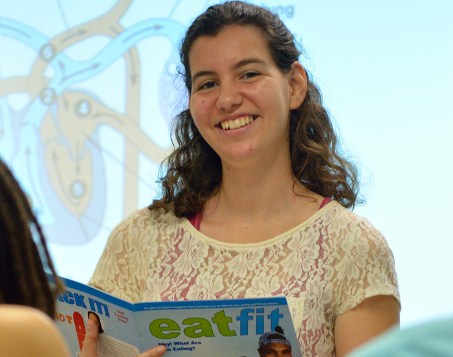
Deana Blansky leading a session for young adolescents on health and fitness - Mark Vorreuter

Last year Deanna Blansky ’16 jumped into a new initiative to translate faculty research into hands-on activities for teaching middle-school youth about the brain, health, and science. The initiative aims to develop a six-hour 4-H STEM curriculum on health and the brain and is led by Valerie Reyna, professor and director of the Human Neuroscience Institute in the Department of Human Development, and co-director of the Cornell MRI Facility.

To start, Blansky, a Human Biology, Health, and Society major, developed two modules, one on nutrition and fitness and another on breast cancer genetics, based on Reyna’s ongoing research.  She piloted these modules with middle school campers at Bristol Hills 4-H Camp in Canandaigua, New York as part of her summer Cornell Cooperative Extension internship. Both modules combined aspects of health and neuroscience, while providing an interactive learning experience for the campers.

The campers particularly liked the hands-on lessons, such as competing in the nutritional breakfast cook-off and creating model brains they could keep, Blansky said. They had fun comparing breakfast ideas and seemed surprised by how easy it was to create their own healthy meals. They were eager to take their ideas back home, she said.

The combination of outreach through teaching at summer camp and empirical neuroscience research was really rewarding, Blansky concluded. What she learned about the research process, curriculum development and lesson planning for different age groups will come in handy - she is planning on entering the field of medicine and public health, and hopes to incorporate community health into her future career.

This year, Noah Rubin ’16 will be refining the two modules and developing new segments. Rubin is majoring in Policy Analysis and Management and minoring in Computer Science and Math. He joined Reyna’s Laboratory of Rational Decision Making propelled by an interest in human behavior and the neuroscience behind it. An interest, he says, that was sparked in high school after reading a story about a man who had developed software that predicted investing behavior based on reactions to current events.

The new and revised modules will be piloted with youth this summer, with the plan of eventually making them more broadly available.

By H. Roger Segelken
Reprinted from Cornell Chronicle January 17, 2014

Sternberg
Sternberg

Psychologist Robert J. Sternberg has been appointed professor of human development at the College of Human Ecology, effective Feb. 1.

Announcing the appointment, Alan Mathios, the Rebecca Q. and James C. Morgan Dean of the College of Human Ecology, called Sternberg an “outstanding scholar and engaging teacher” and said: “His work closely aligns with the strong tradition of scholarship in the fields of cognitive and social development that currently exist in the Department of Human Development. This appointment caps a series of new hires that will significantly increase the department’s footprint in developmental psychology and will contribute to the strength of psychology more broadly at Cornell.”

Sternberg, who served most recently as president and professor of psychology and education at the University of Wyoming, said: “What excites me about Cornell is that it combines a land-grant mission with a commitment not only to maintaining its overall excellence, but to striving constantly to be better and even the best at what it does.” He added: “My world view and my research are very closely aligned with the ecological/contextualist tradition espoused by Urie Bronfenbrenner, so I feel like a particularly good fit to the Department of Human Development, in particular, and the College of Human Ecology, in general.”

With research interests in intelligence, creativity, wisdom, thinking styles, leadership, ethics, and love and hate, Sternberg is a past president of the American Psychological Association. He also was president of the Eastern Psychological Association, the Federation of Associations in Behavioral and Brain Sciences, and the International Association for Cognitive Education and Psychology, as well as treasurer of the Association of American Colleges and Universities.

Sternberg earned his B.A. in psychology (1972) at Yale University and his Ph.D. in psychology (1975) at Stanford University. He holds 13 honorary doctorates from 11 countries. Sternberg is the author or co-author of more than 1,500 publications and was principal investigator of grants totaling more than $20 million.

Before his tenure at the University of Wyoming in 2013, Sternberg was provost and senior vice president at Oklahoma State University 2010-2013, where he also served as Regents Professor of Psychology and Education and the George Kaiser Family Foundation Chair of Ethical Leadership.

At Tufts University, Sternberg was dean of the School of Arts and Sciences and a professor of psychology and education 2005-10. At Yale University from 1975-2005, he served in a number of distinguished roles, including as a professor of psychology and of management, as the IBM Professor of Psychology and Education, and as founder and director of the Center for the Psychology of Abilities, Competencies and Expertise.

Calling his new department at Cornell “the top human-development group in the country,” Sternberg added: “I never have felt so welcome in my life. My wife, Karin, our just-turned 3-year-old triplets, Samuel, Brittany and Melody, and I are very excited and enthusiastic about our move to Ithaca.”


DeRosa
DeRosa

Last fall, the department of Human Development welcomed two more neuroscience researchers, husband and wife Adam Anderson and Eve DeRosa, from the University of Toronto. Eve De Rosa is associate professor in the department of human development and Rebecca Q. and James C. Morgan Sesquicentennial Faculty Fellow. DeRosa’s research focuses on the neurochemistry of cognitive processes such as learning, attention, and memory. She takes a comparative cognitive neuroscience approach, employing neuroimaging and behavioral measures in humans and additional measures in rodents, to gain deeper insights into how human behavior and the underlying neurochemistry changes with age.


Anderson 110x150
Anderson

Adam Anderson is associate professor in the department of human development. His research explores the psychological and neural underpinnings of emotions—what they are, how they are generated in the brain, and how we regulate them. Although much of psychology focuses on understanding and treating disorders, Anderson is interested in human flourishing and the nature of happiness—what it is and its function and adaptive value. His research considers all emotions as evolutionarily selected biological adaptations, having their own rationality intended to help us navigate the physical and social environment.

By Karene Booker
Reprinted from Cornell Chronicle, December 10, 2013

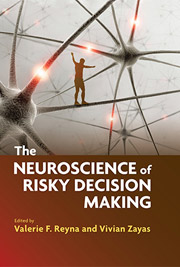
NeuroRisky12-9Risky choices – about sex, drugs and drinking, as well as diet, exercise, money and health care – pervade our lives and can have dire consequences. Now, a new book aims to help us understand the neural roots of bad decisions. “The Neuroscience of Risky Decision Making” (APA Books) synthesizes the research in this relatively young field for the first time, and introduces new models of brain function to explain and predict risky behavior.

“The harm caused by risky decision-making is enormous – understanding how the brain processes risks and rewards is the key to unraveling the mystery of irrational decision-making in real life,” said Valerie Reyna, professor of human development, director of the Human Neuroscience Institute in the College of Human Ecology and co-director of the Cornell MRI Facility.

“We anticipate this work will transform the next phase of research in the field and inform policy and practice innovations that can save lives and improve health and well-being,” said Reyna, who co-edited the volume with Vivian Zayas, associate professor of psychology at Cornell.

In the book, leading neuroeconomists, neuroscientists and social scientists discuss recent findings on why people take risks and how risky choices shift in different circumstances and across the life span.

An initial chapter by Reyna and Scott A. Huettel, neuroscientist at Duke University, sums up the research on how the brain responds during risky decision-making and introduces a new theoretical framework for explaining the mechanisms that drive behavior. The chapters that follow cover such topics as how risky decision-making changes dramatically from childhood to adolescence as a function of age-related changes in brain structure; the role of emotional regulation, self-control and personality differences in risky choices; and the social, cognitive and biological factors that shape risky behavior. The final chapter presents evidence for a new “triple” process model of how rewards and losses are evaluated in the brain, potentially resolving conflicts between current single and dual system theories.

The book is intended for researchers, students and professionals in the fields of social, cognitive and affective neuroscience; psychology; economics; law and public health.

This volume is part of the American Psychological Association’s Bronfenbrenner Series on the Ecology of Human Development, affiliated with the Bronfenbrenner Center for Translational Research, with authoritative contributions from leading experts in the field.

Reyna will discuss her new book in a “Chats in the Stacks” book talk Feb. 10 at noon in 160 Mann Library.

Karene Booker is extension support specialist in the Department of Human Development.

By Karene Booker
Reprinted from Cornell Chronicle, November 27, 2013

Mendle
Mendle

Puberty can be a tough time for all youth, but for girls who have been sexually abused, it spells double trouble. Sexually abused girls reach puberty before other girls, a new study finds, and early puberty increases their risk of having emotional problems.

“Early maturing girls are already more vulnerable to mood problems than other kids, but this risk seems to be magnified for girls with histories of sexual abuse,” said Jane Mendle, assistant professor of human development in Cornell’s College of Human Ecology, whose study was published online (Aug. 28) in the Journal of Research on Adolescence ahead of print.

“Girls who reach puberty ahead of peers are substantially more likely to be targets of peer sexual harassment and receive a high number of unsolicited comments on their bodies,” said first author Mendle.

For those with histories of sexual abuse (about one in five girls in the United States), these challenges and pressures may become a tipping point for emotional difficulties such as depression and anxiety, she said.

Mendle and colleagues studied 100 girls in foster care, all of whom had experienced maltreatment early in childhood. They looked at the type of maltreatment (physical abuse, sexual abuse or neglect), emotional symptoms and level of physical maturity reported at two points, two years apart.

The team found no direct effects of abuse on the girls’ emotional symptoms. Rather, they found that the number of sexual abuse instances, but not physical abuse or neglect instances, was linked to earlier pubertal timing. And it was these earlier developing girls that had more symptoms of depression, anxiety and social withdrawal. The study showed that girls’ emotional problems were directly related to their experiences at puberty – not to what happened to them early in life, the authors concluded.

“In addition to individual interventions [to help early maturing girls], another target might be our collective social response to early puberty,” said Mendle.

“Peers, caregivers, teachers and other adults have a tendency to react to children based on their observable – rather than chronological – age. Those reactions can be very powerful for how girls respond and interpret the challenges of growing up.”

The study “Linking Childhood Maltreatment With Girls’ Internalizing Symptoms: Early Puberty as a Tipping Point,” was co-authored by Leslie D. Leve and Mark Van Ryzin of the University of Oregon and Misaki N Natsuaki of the University of California, Riverside. It was supported in part by the National Institute on Drug Abuse.

Karene Booker is an extension support specialist in the Department of Human Development.

By Karene Booker
Reprinted from Cornell Chronicle November 14, 2013

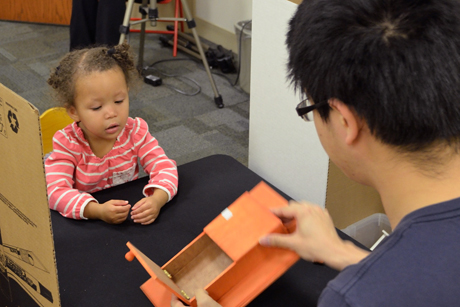
Graduate student Yue Yu conducts an imitation toy test in Jushnir's Early Chilhood Cognition Laboratory with Saffron Gold-Rodgers.
Graduate student Yue Yu conducts an imitation toy test in Jushnir's Early Chilhood Cognition Laboratory with Saffron Gold-Rodgers. - Mark Vorreuter

From infancy, children learn by watching and imitating adults. Even when adults show them how to open a latch or solve a puzzle, for example, children use social cues to figure out what actions are important. But children read these cues differently depending on their age: Older children, interestingly, are more likely, not less likely, to faithfully imitate actions unnecessary to the task at hand, reports Cornell research.

The findings imply that children of different ages have different expectations when they watch and learn from adults, based on their growing social understanding, say authors Yue Yu, graduate student in the field of human development, and Tamar Kushnir, the Evalyn Edwards Milman Assistant Professor of Child Development in the College of Human Ecology, in a study published online in Developmental Psychology (Aug. 26) ahead of print.

“Understanding what causes children to imitate in any given situation, and especially to imitate actions that seem to have no obvious purpose, sheds light on how children’s minds work and what influences their learning,” Kushnir said.

To explore how age and social context influence children’s imitation behavior, the researchers conducted two experiments with 2- and 4-year-olds. In one, children played one of three games with the experimenter (copying the experimenter’s hand gestures, taking turns to find and fit a puzzle piece, or a non-interactive drawing game). Then, they played a puzzle-box game after watching the experimenter show two actions on the toy and retrieve a puzzle piece. In half the trials, only the second action was necessary to recover the puzzle piece.

The researchers found that the 4-year-olds faithfully imitated both necessary and unnecessary actions to get the puzzle piece, regardless of the game they played beforehand; 2-year-olds, however, were heavily influenced by the context set up by the prior game. They were more likely to faithfully imitate unnecessary actions after playing the copying game and more likely to selectively emulate just the necessary action after playing the puzzle-solving game.

A second experiment ruled out the possibility that the 2-year-olds were merely primed to copy anyone – their strategies were not influenced by the copy game when they played it with a different experimenter. This suggests that toddlers in the first experiment were actively engaged in a social interaction with a particular individual from which they inferred goals for the following game, Yu and Kushnir concluded. Their findings underscore the important role that children’s developing social knowledge plays in what and how they learn, they said.

When toddlers watch adults, what they pay attention to and imitate appears highly dependent on the context and expectations set up by the adult, and this points to the importance of establishing rapport before trying to teach them something, said Yu.

Preschoolers, on the other hand, are more likely to view all adult’s purposeful actions as part of the social interaction, perhaps even as social norms, and thus imitate them as faithfully as possible. This enables imitation to be a source, not just for learning about objects (e.g., how a latch works), but for rich and accurate cultural transmission, Yu added.

Or for embarrassment, depending on what you just demonstrated in front of your preschooler.

The study, “Social Context Effects in 2- and 4-year-olds’ Selective Versus Faithful Imitation,” was supported in part by the National Science Foundation.

Karene Booker is an extension support specialist in the Department of Human Development.

By H. Roger Segelken
Reprinted from Cornell Chronicle, October 30, 2013

Evans
Evans

The chronic stress of childhood poverty can trigger physical changes that have lifelong psychological effects, a study of adult brains has shown.

“Some of the anxiety disorders, depression, post traumatic stress disorders, impulsive aggression and substance abuse we’re seeing in adults might be traced to a stressful childhood,” says Cornell’s Gary W. Evans, the Elizabeth Lee Vincent Professor of Human Ecology.

The environmental and developmental psychologist joined researchers from three other universities to publish findings in the journal Proceedings of the National Academy of Sciences as “Effects of childhood poverty and chronic stress on regulatory brain function in adulthood.” The 15-year study confirms something Evans has long suspected: “Early experiences of poverty become embedded in the brain. Exposure to chronic stress in early childhood – when the amygdala and prefrontal cortex are rapidly developing – produces lasting neurological changes,” he says.

The longitudinal study followed 49 rural 9-year-olds for 15 years – checking in at ages 9, 13, 17 and 24. “Even if the 24-year-olds had escaped poverty and were making a comfortable living,” Evans says, “functional magnetic resonance imaging scans of two parts of the brain that process emotion, the prefrontal cortex and the amygdala, revealed neural patterns for emotion regulatory dysfunction.

“Chronic stresses of childhood poverty may make it harder to regulate your emotions and this remains whether or not you are upwardly mobile as an adult,” he adds.

The report by researchers at the University of Michigan, University of Denver, University of Illinois at Chicago and Cornell said “… children living in poverty are more likely to be exposed to chronic multiple stressors, including violence, family turmoil, separation from family members and substandard living environments.”

Pilyoung Kim, M.A. ’07, Ph.D. ’09, assistant professor in the Department of Psychology at the University of Denver, is the lead author on the paper. Support for the long-term study came from the National Institutes of Health, William T. Grant Foundation, John D. and Catherine T. MacArthur Foundation and the Robert Wood Johnson Foundation.