
Author Archives: ktb1@cornell.edu

By H. Roger Segelken
Reprinted from Cornell Chronicle October 30, 2013
Anderson 110x150
Anderson

Some people are genetically predisposed to see the world darkly, according to a study from the laboratory of a researcher now on the faculty of Cornell’s College of Human Ecology.

Adam K. Anderson, associate professor of human development, is continuing his research on emotions, genetics and perception, which began at his laboratory at the University of Toronto in collaboration with scientists at the University of British Columbia (UBC). Their study, published in September in Psychological Science, found a previously known gene variant causing some individuals to perceive emotional events – especially negative ones – more acutely than others.

“This genetic variation contributes to how emotions bias individuals to see the same world in different ways,” says Anderson. “More than just how we may later remember, these findings suggest genetics influence how our brains pick and choose which events to perceive in the first place.”

The gene in question is the ADRA2b deletion variant, which influences the neurotransmitter norepinephrine. Previously found to play a role in the formation of emotional memories, the new study shows that the ADRA2b deletion variant also plays a role in real-time perception.

Some 200 study participants were shown positive, negative and neutral words in a rapid succession, each at 1/10th of a second. While all individuals perceived positive words better than neutral words, participants with the ADRA2b gene variant were more likely to perceive negative words than others.

“These individuals may be more likely to pick out angry faces in a crowd of people,” says Rebecca M. Todd of UBC’s Department of Psychology. “Outdoors, they might notice potential hazards – places you could slip, loose rocks that might fall – instead of seeing the natural beauty.”

The findings shed new light on ways in which genetics – combined with other factors such as education, culture and moods – can affect individual differences in emotional perception and human subjectivity, the researchers say.

Future work on this topic in Anderson’s laboratory intends to examine whether individuals with these very same genetic variants, depending on their environment and stage of development, can be coaxed to enhance perception of the positive rather than the negative.

The study, “Genes for Emotion-Enhanced Remembering Are Linked to Enhanced Perceiving,” was funded in part by the Canadian Institutes of Health Research.

Reprinted from Cornell Chronicle, October 21, 2013

Pillemer
Pillemer

Similarities in personal values and beliefs between an adult child and an older mother keeps that child in favor over the long-term, and that preference can have implications for mothers’ long-term care, reports a new Cornell study.“Not only does her favoritism affect adult sibling relationships, but also the patterns of caregiving for mothers," said co-author Karl Pillemer, professor of human development in the College of Human Ecology at Cornell. “Knowing that favoritism tends to be relatively stable can be helpful to practitioners assisting families with their older relatives.The study, published in the October issue of the Journal of Marriage and Family (75:5), reports that about three-quarters of the 406 mothers in the study, who were 65-75 years of age at the study’s onset, identified the same child as their favorite and preferred caregiver at the start and end of the seven-year study.

The mother’s perception of similarity between herself and her child was one of the biggest predictors of who remained the favorite, Pillemer said. He added that recent research with co-author Jill Suitor of Purdue University has found that mothers tend to prefer their “favorites” as their caregivers, compared with her other children.

The findings of the new study, co-authored with Suitor and Megan Gilligan of Iowa State University, are based on data from the Within-Family Differences Study, in which data were collected seven years apart from the same mothers.

Gender similarity also was a consistent factor to show long-term favoritism, which is not surprising because the mother-daughter connection has been shown in previous research to typically be the strongest, closest and most supportive parent-child relationship, Pillemer said.

In addition to looking at personal values, the researchers also looked at whether a child's financial independence, adult roles as a spouse or parent themselves, consistent employment and lawful behavior influenced which child remained the favorite. What was surprising is that whether a child was married, divorced or independent mattered much less than sharing personal values, said Suitor, who is a member of the Center on Aging and the Life Course.

"These mothers are saying that if I can't make my own decisions involving my life then who can best make these decisions for me? Who thinks like I do?" Suitor said. "Who has the same vision in life that I do, has a pretty good sense of what I would do? This is incredibly important with issues related to caregiving, and that is why understanding these family dynamics is so important."

On the other hand, identifying what drove changes when a child fell out of favor has proven much more difficult, the researchers noted.

"One of the few predictors of changes was when children stopped engaging in deviant behaviors, such as substance abuse, during the seven years, and then their mothers were more likely to choose them as the children to whom they were most emotionally close," Gilligan said.

Suitor said, "This is an interesting change because if a child engaged in deviant behaviors seven years ago but then stopped, they were even more likely to be chosen than were siblings who never engaged in deviant behaviors."

Suitor, Pillemer and Gilligan are planning to extend the Within-Family Differences Study to include interviewing Baby Boomers about their adult children.

The study, “Continuity and Change in Mothers' Favoritism Toward Offspring in Adulthood,” was funded by the National Institute on Aging.

In the same way that microscopes and telescopes have allowed scientists to explore the mysteries of cells and the cosmos more deeply, a new research instrument based in the College of Human Ecology promises to reveal many of the hidden factors driving human behavior. The device, a powerful 3-tesla MRI machine, is enabling new areas of research at the confluence of the social, biological, and physical sciences.

By allowing the college’s behavioral scientists to peer inside working brains, the technology will help them to generate new insights into the development and function of the brain—a massively complex organ that researchers are only beginning to decode. Cornell scientists, by linking the biological mechanisms of the brain to behavior, are making important discoveries related to Alzheimer’s and other neurodegenerative diseases, risk-taking and decision-making, and overall cognitive health and development. Read more

Tamar Kushnir, the Evalyn Edwards Milman Assistant Professor of Human Development, is quoted in this story about how babies think.

In the past few decades we've learned that babies' brains are structurally quite different from those of adults and they also function in a way that makes them better than adults at learning new things. In other words, babies seem to be specially designed for exploration and finding out how things work. They're little scientists…at least, that is, until those exploratory habits get replaced over time by less flexible thinking styles. Read more

Another story on the research by Gary Evans and colleagues highlights the potential negative impact of stress and poverty experienced during childhood has on the ability to regulate emotions in adulthood.

The research showed that children who grew up poor were more likely to experience emotional regulation problems later on in adulthood, and also had differences in activity in the amygdala and prefrontal cortex, suggesting that the stress-burden of growing up poor may be an underlying mechanism that accounts for the relationship between poverty as a child and how well your brain works as an adult. Read more


Experts explore roots of healthy aging
Researchers gathered on campus Oct. 3-4 for the Fourth Biennial Urie Bronfenbrenner Conference, “New Developments in Aging, Emotion and Health” to better understand the interplay between emotions and health across the lifespan.
Breakthrough discerns normal memory loss from disease
A new method for analyzing data from simple memory tests reliably distinguishes memory declines associated with healthy aging from the more-serious memory disorders years before obvious symptoms emerge.
Memory-related brain network shrinks with aging
Research by Nathan Spreng find that brain regions associated with memory shrink as adults age, and this size decrease is more pronounced in those who go on to develop neurodegenerative disease.
Life purpose buffers bad moods triggered by diversity
Being in the minority in an ethnically diverse crowd is distressing, regardless of your ethnicity, unless you have a sense of purpose in life, reports a study led by Anthony Burrow.
Research finds kids share when it’s done by choice
New research by Tamar Kusnir suggests that allowing children to freely choose to give valuable possessions to another leads them to share more in the future.
Book shows how family, culture shape personal stories
Qi Wang’s new book combines theory, research, examples and personal anecdotes to convey a message: The stories we remember and tell about ourselves are conditioned by one’s time and culture.
Nearby daughter most likely to be mom’s caregiver
Among adult siblings, the daughter who lives closest is the most likely to become the caregiver when their mother experiences health problems reports Karl Pillemer.

 Students in the News

Human Ecology students dive deep into research
Undergraduates in the field of Human Development worked on summer research projects from child development to neuroscience.
Undergrads go to camp – and study teen transitions
A team of undergraduates working with Jane Mendle piloted a study testing expressive writing interventions with adolescent girls at 4-H Camp Bristol Hills this summer.
Summer interns present research at poster session
Six undergraduates in the field of human development were among the 26 students participating in the the CCE internship program this summer.

More Stories

Scientists discover a way to erase traumatic memories

What does it mean to be “mostly heterosexual”?

Daughters (still) are the caregivers Life and the adolescent brain

Life and the adolescent brain

New Resources

Fifty Years of Family Change
Brainfacts.org
The Dana Foundation
The Adolescent Health Highlight: Use of Illicit Drugs
Adolescent Development Toolkit


By Karene Booker
Reprinted from Cornell Chronicle, October 15, 2013

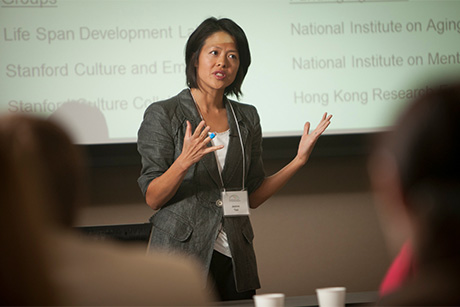
Jeanne Tsai, associate professor of psychology at Stanford University, speaks at the 2013 Biennial Urie Bronfenbrenner Conference - Jason Koski/University Photography
Recent scientific advances demonstrate the profound effects of emotion on physical health, even how long we live and what diseases we die from. Likewise, there is growing evidence for the effects of aging on our emotions. Both streams of research shed light on root causes of disease and pathways to lifelong health, which is why researchers gathered on campus Oct. 3-4 to better understand the interplay between emotions and health across the lifespan.

The Fourth Biennial Urie Bronfenbrenner Conference, “New Developments in Aging, Emotion and Health,” drew scholars from as far away as Europe to share research on the nature of age differences in emotions, how emotions influence health, the underlying biological and behavioral mechanisms, and possibilities for leveraging these discoveries to promote healthy aging.

“We convened a temporary think tank of long-standing and rising leaders in the two fields to create some unlikely encounters and novel ideas,” said Corinna Loeckenhoff, assistant professor of human development in the College of Human Ecology and director of the Cornell Healthy Aging Laboratory. “We expect the intellectual exchange and networking will lead to new conceptual developments as well as policy and translation opportunities with real-world implications,” she said. Loeckenhoff co-organized the conference with Anthony Ong, associate professor of human development.

Many of those who participated are pioneers in their fields. Laura Carstensen, a professor of psychology and the founding director of the Stanford Center on Longevity, for example, is best known for her theory about how people’s motivations change as they age. She reviewed her recent research on leveraging older adults’ preference for the positive to improve health behaviors. Positive messages about the benefits of exercise, it turns out, are more effective than negative messages about risks of inactivity in motivating older adults to walk regularly. Such insights could revolutionize efforts to help America’s growing population of older adults remain active, she said.

Cornell neuroscientist Adam Anderson, associate professor of human development, said that his research suggests that positive emotions are associated with increased cognitive flexibility and creative problem solving, and this may be due to neural changes that impair selective attention. The aging brain, he says, exhibits this same “leaky filter” pattern. More information can slow down thinking, but there’s an upside as well, he proposed – the rose colored glasses of positivity broaden our field of view and help us see remote connections.

Alex Zautra of Arizona State University, who studies resilience and interventions that help people bounce back from stressors and adversity, shared his recent research on the crucial role of social ties in “unlocking” resilience and his initiative to develop online social intelligence training to help people build and maintain social ties.

Participants (who included other renowned scholars such as George Bonanno, Columbia University; Michaela Riediger, the Max Plank Institute for Human Development; and Laura Kubzansky, Harvard School of Public Health) also debated core assumptions about emotional regulation and personality, the effects of culture, environment and technology, and their implications for policy and practice.

The American Psychological Association plans to publish a book based on the papers presented at the conference, which was sponsored by Cornell’s Bronfenbrenner Center for Translational Research, Institute for the Social Sciences and Department of Human Development; the Scientific Research Network on Decision Neuroscience and Aging; Constance F. Ferris; and Liese Bronfenbrenner.

Conference videos

Karene Booker is an extension support specialist in the Department of Human Development.

By Karene Booker
Reprinted from the Cornell Chronicle, September 5, 2013

Charles Brainerd
Brainerd

Cornell researchers have developed a reliable method to distinguish memory declines associated with healthy aging from the more-serious memory disorders years before obvious symptoms emerge. The method also allows research to accurately predict who is more likely to develop cognitive impairment without expensive tests or invasive procedures.

Their results hold promise for detecting cognitive impairment early and monitoring treatment, but also have implications for healthy adults, said Charles Brainerd, professor of human development and the study’s lead co-author with Valerie Reyna, director of the Institute for Human Neuroscience and professor of human development, both in the College of Human Ecology.

Valerie Reyna
Reyna

Their research, “Dual-retrieval models and neurocognitive impairment,” appears online in the Journal of Experimental Psychology: Learning, Memory and Cognition, Aug. 26.

The memory abilities affected by cognitive impairment differ from those affected by healthy aging, the authors say, resulting in unique error patterns on neuropsychological tests of memory. Their theory-driven mathematical model detects these patterns by analyzing performance on such tests and measuring the separate memory processes used.

“With 10 or 15 minute recall tests already in common use worldwide, we can distinguish individuals who have or are at risk for developing cognitive impairment from healthy adults, and we can do so with better accuracy than any existing tools,” said Brainerd.

The notion that memory declines continuously throughout adulthood appears to be incorrect, they say. “When we separated out the cognitively impaired individuals, we found no evidence of further memory declines after the age of 69 in samples of nationally representative older adults and highly educated older adults,” said Reyna.

To develop their models, the team used data from two longitudinal studies of older adults – a nationally representative sample of older adults, the Aging, Demographics and Memory Study, and the Alzheimer’s Disease Neuroimaging Initiative – that include brain and behavioral measures as well as diagnoses for cognitive impairment and dementia.

Specifically, the researchers found that declines in reconstructive memory (recalling a word or event by piecing it together from clues about its meaning, for example, recalling that “dog” was presented in a word list by first remembering that household pets were presented in the list) were associated with mild cognitive impairment and Alzheimer’s dementia, but not with healthy aging. Declines in recollective memory – recalling a word or event exactly – were a feature of normal aging.

Over a period of between one and a half to six years, declines in reconstructive memory processes were reliable predictors of future progression from healthy aging to mild cognitive impairment and Alzheimer’s dementia, and better predictors than the best genetic marker of such diseases.

“Reconstructive memory is very stable in healthy individuals, so declines in this type of memory are a hallmark of neurocognitive impairment,” Reyna said.

Younger adults rely heavily on recollection, Brainerd said, but this method becomes increasingly inefficient throughout mid-adulthood. “Training people how to make better use of reconstructive recall as they age should assist healthy adult memory function,” he said. “Our analytical models are readily available for research and clinical use and could easily be incorporated into existing neuropsychological tests.”

The co-authors of the paper are Carlos Gomes, a graduate student in the field of human development; Anna Kenney ’11, Caroline Gross ’12 and Emily Taub ’10 of Cornell – all of whom helped conduct the research as undergraduates in Brainerd’s lab; and Nathan Spreng, assistant professor of human development and Rebecca Q. and James C. Morgan Sesquicentennial Faculty Fellow in the College of Human Ecology.

The research was supported in part by the National Institutes of Health and the CAPES Foundation, a federal agency under Brazil’s Ministry of Education.

Karene Booker is extension support specialist in the Department of Human Development.

By Karene Booker
Reprinted from Cornell Chronicle, September 19, 2013

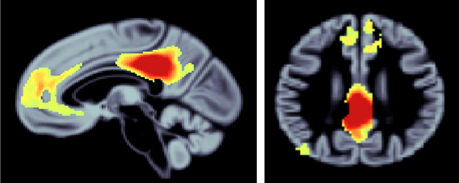
Network of brain regions, highlighted in red and yellow, show atrophy in both healthy aging and neurodegenerative disease. The regions highlighted are susceptible to normal aging and dementia.

Brain regions associated with memory shrink as adults age, and this size decrease is more pronounced in those who go on to develop neurodegenerative disease, reports a new study published Sept. 18 in the Journal of Neuroscience (Vol. 33:38). The volume reduction is linked with an overall decline in cognitive ability and with increased genetic risk for Alzheimer’s disease, the authors say.

“Our results identify a specific pattern of structural brain changes that may provide a possible brain marker for the onset of Alzheimer’s disease,” said Nathan Spreng, assistant professor of human development and the Rebecca Q. and James C. Morgan Sesquicentennial Faculty Fellow in Cornell’s College of Human Ecology.

The study is one of the first to measure structural changes in a collection of brain regions – not just one single area – over the adult life course and from normal aging to neurodegenerative disease, said Spreng, who co-authored the study with Gary R. Turner of York University in Toronto.

Overall, they studied brain data from 848 individuals spanning the adult lifespan, using data from the Open Access Series of Imaging Studies and the Alzheimer’s Disease Neuroimaging Initiative (ADNI). About half of the ADNI sample was assessed multiple times over several years, allowing the researchers to measure brain changes over time and determine who did and did not progress to dementia.

The researchers found that brain volume in the default network (a set of brain regions associated with internally generated thoughts such as memory) declined in both healthy and pathological aging. The researchers noted the greatest decline in Alzheimer’s patients and in those who progressed from mild cognitive impairment to Alzheimer’s disease. Reduced brain volumes in these regions were associated with declines in cognitive ability, the presence of known biological markers of Alzheimer’s disease and with carrying the APOE4 variant of APOE gene, a known risk factor for Alzheimer’s.

“While elements of the default network have previously been implicated in aging and neurodegenerative disease, few studies have examined broad network changes over the full adult life course with such large participant samples and including both behavioral and genetic data,” said Spreng. “Our findings provide evidence for a network-based model of neurodegenerative disease, in which progressive brain changes spread through networks of connected brain regions.”

The study, “Structural Covariance of the Default Network in Healthy and Pathological Aging,” was supported in part by the Canadian Institutes of Health Research.

Karene Booker is an extension support specialist in the Department of Human Development.

By Ted Boscia
Reprinted from the Cornell Chronicle, September 3, 2013

Burrow
Burrow

Being in the minority in an ethnically diverse crowd is distressing, regardless of your ethnicity, unless you have a sense of purpose in life, reports a Cornell developmental psychologist.

Anthony Burrow, assistant professor of human development in the College of Human Ecology, led the study, which was conducted on Chicago trains. The findings shed light on how people encounter diversity in everyday settings at a time when the United States is more racially mixed than ever, with demographic trends pointing to a more multicultural melting pot in decades to come.

In two experiments, college students reported their mood as they rode a train from Chicago’s North Side toward the city center for 14 consecutive stops, while Burrow’s team privately recorded naturally occurring changes to the overall ethnic and gender makeup of the car’s passengers during the trip. For the first study, all 111 participants filled out a short questionnaire to assess their life purpose prior to boarding. In the second study, before riding, half of the 116 participants completed a 10-minute writing exercise about life purpose, while the others responded to a question about movies.

Participants’ negative mood heightened as the ratio of people from different ethnic backgrounds aboard the train increased, regardless of their own race and after controlling for various factors, such as an individual’s personality, familiarity with metro trains and perceived safety of the surrounding neighborhoods. In both studies, however, those who had a sense of purpose or had written about their life aims did not experience the worsened mood associated with riding among a diverse crowd.

“This research is among the first to show negative reactivity to diversity occurs dynamically within people, and not just between them,” Burrow said. “That is, it is not simply that people who reside in more ethnically diverse communities experience greater distress than those living in less ethnically diverse communities, as suggested by past studies. Now we can see that when a person is in a more ethnically diverse setting, they feel more distressed than when they are in less ethnically diverse settings.”

But the negative feelings vanished in purpose-driven individuals. Burrow, whose research focuses on the value of purpose, particularly among teens and young adults, suspects that it enabled participants to look beyond themselves to appreciate their role in the world and to build the psychological resilience necessary to overcome adversity.

“There is evidence that focusing on personally meaningful and valued goals can buffer the negative effects of stress by allowing individuals to reinforce a sense of who they are,” he said. “This suggests that creating opportunities for individuals to cultivate a sense of purpose is important as we move forward as a society.”

Burrow warned that the study should not be misread as rejecting multiculturalism, even if diversity can be distressing for people.

“Neither previous research nor our interpretation of the current findings suggest that diversity is inherently problematic,” Burrow said. “In fact, there are many reasons to believe ethnically diverse friendships, classrooms and workplaces are optimal for high-quality outcomes.”

The study, “Derailed by Diversity?: Purpose Buffers the Relationship Between Ethnic Composition on Trains and Passenger Negative Mood,” was published online Aug. 27 in Personality and Social Psychology Bulletin and was co-authored by Patrick Hill of Carleton University.

Ted Boscia is assistant director of communications for the College of Human Ecology.